Dialogues between Artisans and Designers


BROOMS AND ESPARTO BRUSHES
ESPARTO materials
esparto work ISIDORO RAMOS
design VANESSA DOMINGUES
Reviving the art of working with esparto grass, this collection of products draws on traditional details and techniques, applying them to enhance everyday objects. The collection includes a floor broom, two hand brooms, a brush, and a mushroom brush.


OLLA LONGA
To kick off the workshops, we asked the artisans to bring us issues that concerned them and projects they were interested in working on. Ricardo Lopes brought us an “olla” that he had dug up from his backyard, where he had tested this ancient irrigation system, which is widely used in arid regions. We immediately decided that this would be a must-do project, given the global context and the drought plaguing the Algarve region in particular.

OLLA LONGA
Materials RED CLAY
pottery RICARDO LOPES
design HENRIQUE RALHETA, HUGO DA SILVA AND VANESSA DOMINGUES
Ollas are unglazed clay pots that, thanks to the material’s microporosity, allow plant roots to draw water as needed when buried in the ground, making highly efficient use of this scarce resource.
This model is designed for medium-sized home gardens planted in rows, with each Olla covering an area of 90 x 60 cm.

POTS STORAGE
Materials RED CLAY
pottery RICARDO LOPES
design HENRIQUE RALHETA
Inspired by the way Ollas work (in which the roots draw water through the unglazed clay as needed), this pot design was created, featuring a water reservoir built into its walls. This alternative to traditional watering allows for the efficient use of water and much longer intervals between waterings.


VEGETABLE BOXES
Materials CLAY
pottery RICARDO LOPES
design VANESSA DOMINGUES
Drawing on clay’s natural temperature and humidity-regulating properties, a system of containers for storing vegetables has been created to help extend their shelf life and keep them fresh.

BREAD BOX
Materials CLAY PINE
pottery RICARDO LOPES
woodworking WESLEY SACARDI
design VANESSA DOMINGUES
Drawing on clay’s natural ability to regulate temperature and humidity, a bread box was designed to help keep bread fresh longer. The wooden lid is designed to double as a cutting board.

BIG-HEADED POTS
materials BODIES IN CLAY OR COPPER, PALM COVERS
work in palm SÓNIA MENDEZ
boiler shop NUNO PALMA
pottery RICARDO LOPES
design HENRIQUE RALHETA
Drawing inspiration from memories of Loule’s centennial carnival, jars featuring traditional silhouettes are adorned with whimsical lids. Here, the lids serve as an expression of creative freedom, proving that the application of traditional techniques can transport us to new worlds.

BOTTLE
Materials CLAY
pottery RICARDO LOPES
design HUGO DA SILVA
Inspired by the splendor of the Islamic Baths in Loulé, where a wealth of fragmented pieces reveals a meticulous process of reconstruction, we felt compelled to reflect on how to reproduce this blend of forms. However, when shaped on the potter’s wheel, everything transforms and comes together in surprising ways. Ricardo’s masterful hands capture the form in each piece, but the result is unique and unrepeatable.

ABANICOS
materials PALM AND OLIVE WOOD (from pruning)
work in palm SÓNIA MENDEZ
cabinetmaker WESLEY SACARDI
design HENRIQUE RALHETA
Fans are one of the most iconic items produced from palm leaves. Still used today to stoke the embers of a fire, they continue to be made by the artisans at the workshop. Typically, the handle is made from a cane or a branch of aloendro secured with a bent nail.
What we propose here is a slight update with the creation of a sturdier handle, secured with a palm-leaf stitch, without the use of any non-natural materials.

PALM BRUSHES
Materials PALM AND OLIVE WOOD
work in palm SÓNIA MENDEZ
woodworking WESLEY SACARDI
design HENRIQUE RALHETA
These versatile brushes combine beautiful olive wood from local prunings with traditional palm fiber, which has been split here into fine, durable strands. The interweaving of these two materials creates unique graphic patterns.

FIREWOOD RUG
ESPARTO materials
esparto work ISIDORO RAMOS
design VANESSA DOMINGUES
Inspired by the sturdiness of esparto grass and its use in sturdy, durable baskets, this firewood-carrying mat was created to reimagine the practical application of this material, featuring a simpler design and emphasizing ease of use.

MICRO-ENTERPRISE JEWELLERY BOX
PALM materials
SONIA MENDEZ
design HUGO DA SILVA
In addition to the better-known palm-leaf works, museums house pieces that showcase a meticulous, careful, and delicate use of palm leaves that are even thinner than usual. This was the challenge we presented to Sonia Mendez, whose skill allowed us to create forms inspired by the Arab influences of Algarve chimneys. These forms were simplified to highlight the craftsmanship and meticulousness of the work.

JEWELRY BOX
Materials COPPER
JORGE DÓRIA boiler shop
design VANESSA DOMINGUES
Paying homage to the historic art of copperwork, typical of Loulé, a small jewelry box has been designed. Its shape is inspired by classic cataplanas, and it revives traditional craftsmanship with meticulous care and delicacy in every hammer stroke that shapes it.

SPROUTED BOWLS
Materials COPPER
boiler shop ANALIDE CARMO
design HUGO DA SILVA
The bowls emerged from an effort to create pieces with organic shapes while minimizing waste of copper sheet as much as possible. During the design process, the shapes emerge like bubbles that fit together and deform harmoniously. As they take on volume, unique undulations appear, and each piece grows in a distinct way.

MESH SHELF
materials PALM, CANA
work in palm OLIMPIA CABRITA
design HENRIQUE RALHETA
Palm weaving with a cane core is a beautiful traditional technique that deserves to be promoted. It has been widely used in accessories such as bags, baskets, trays, and serving platters. In this product collection, the material’s potential was explored in three areas: durability, geometric patterns, and scale, moving toward furniture design and pushing the boundaries of the technique’s versatility.

SHELF WITH POCKET
materials PALM, CANA
work in palm OLIMPIA CABRITA
design HUGO DA SILVA
Palm weaving with a cane core is a beautiful traditional technique that deserves to be promoted. It has been widely used in accessories such as bags, baskets, trays, and serving platters. In this product collection, the material’s potential was explored in three areas: durability, geometric patterns, and scale, moving toward furniture design and pushing the boundaries of the technique’s versatility.

BEDSIDE TABLE
BEDSIDE TABLE
materials PALM, CANA
work in palm OLIMPIA CABRITA
design VANESSA DOMINGUES
Palm weaving with a cane core is a beautiful traditional technique that deserves to be promoted. It has been widely used in accessories such as bags, baskets, trays, and serving platters. In this product collection, the material’s potential was explored in three areas: durability, geometric patterns, and scale, moving toward furniture design and pushing the boundaries of the technique’s versatility.

ROLLER BENCH
Materials ESPARTO AND WOOD
esparto work ISIDORO RAMOS
woodworking WESLEY SACARDI
design HENRIQUE RALHETA
This piece revives the “rodilhas”—small, round seats traditionally used throughout the country on benches, chairs, or directly on the floor. In other settings, they were used to hold pitchers or pots. Here, we’ve incorporated them into a fixed structure, transforming it into a bench. But because it hasn’t forgotten its history, it’s called the Rodilho Bench.

FABRIC
Materials PORTUGUESE WOOL, NATURAL DYEING
WITH CISTUS, POMEGRANATE PEELS, LICHENS AND EUCALYPTUS LEAVES
weaving SUSANA MENDEZ
design HUGO DA SILVA
Through a joint study of the patterns found on traditional woven saddlebags and the diamond pattern of Alentejo blankets, a unique and asymmetrical fabric emerged. Each weaving phase dedicated to a specific pattern is reflected in the final result, sometimes denser and more uniform, other times more spaced out and simple, allowing light to pass through. The fabrics are dyed by hand using natural materials found in the Barrocal and the Algarve mountains.

ASK PROCESS
Materials COPPER AND OLIVE WOOD
boiler shop NUNO PALMA
woodworking WESLEY SACARDI
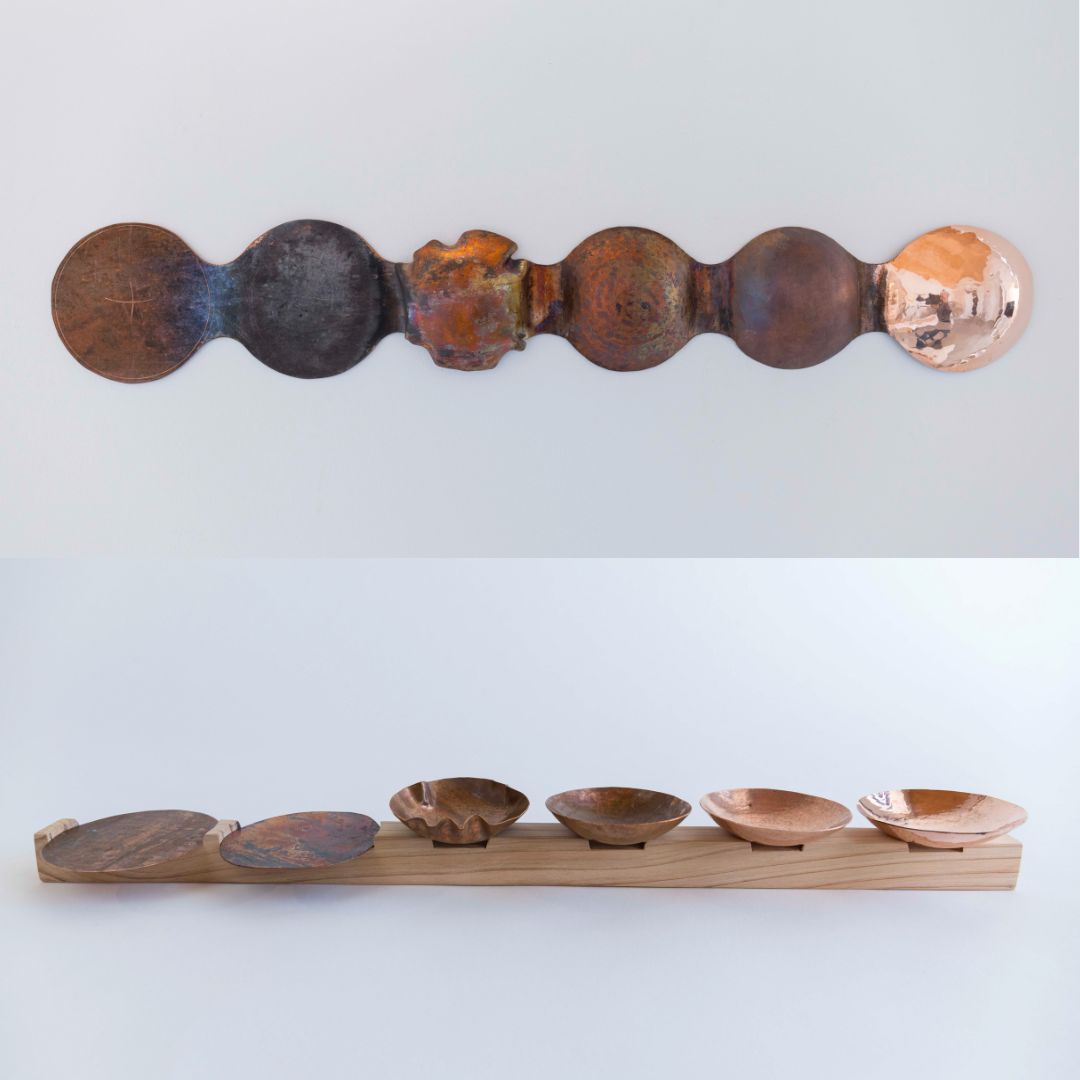
Shaping a copper piece involves different stages during which the material takes on various colors and textures—a captivating process for anyone watching the coppersmiths at work.
In this piece, we offer a glimpse of the entire process through a chronology of the work that reveals:
1. cutting,
2. annealing to soften the metal,
3. hammering to shape and harden,
4. sandblasting for cleaning,
5. finishing hammering,
6. final polishing.
The wall piece is more decorative in nature; the tabletop piece is more utilitarian, but what both seek to achieve is the celebration of this craftsmanship.
SEED BOWLS
Materials COPPER
boiler shop JURGEN CRAMER
design HUGO DA SILVA
The art of copperwork arises from hammering the sheet metal, which shapes it into distinct forms and volumes. Initially, we wondered how to imbue a flat sheet of copper with value, volume, and visual weight. This question led us to create a double-layered piece, where the inner void is perceived as volume. The combination with decorative textures developed by Jurgen brings the piece to life, resembling seeds about to sprout.

CEILING LAMP
Materials COPPER
boiler shop JURGEN CRAMER
design VANESSA DOMINGUES
This lamp explores the flexibility of copper, highlighting the simple sheet metal that is steeped in the history of copper craftsmanship. The polished surface helps reflect light in various directions, following the shape of the piece.

ROCHA DOS SOIDOS RUG
ESPARTO materials
esparto work MARIA JOSÉ RAMOS
design HUGO DA SILVA
Maria José Ramos is one of the artisans keeping the art of esparto weaving alive in the village of Sarnadas. Whenever she leaves her home, she gazes upon Rocha dos Soidos—an imposing rock formation where vegetation stubbornly thrives, creating a play of textures that, in this piece, inspired her to blend various esparto weaving techniques.

FRUIT BOWL VALE DAS SARNADAS
ESPARTO materials
esparto work MARIA JOSÉ RAMOS
design HENRIQUE RALHETA
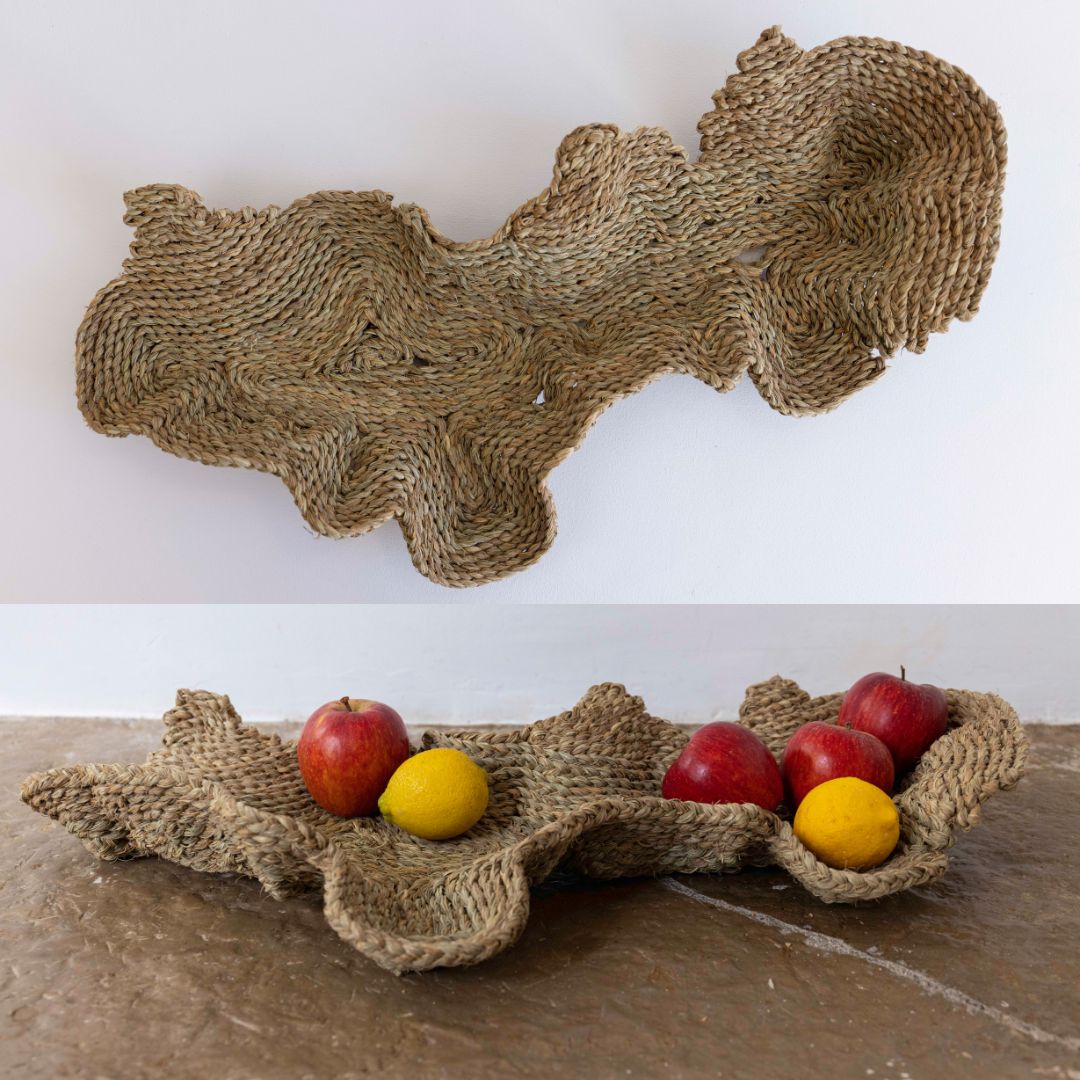
Crafts are, by their very nature, closely tied to the local area. Places shape people and influence their practices. The village of Sarnadas was once a major center for esparto grass production. Recently, the seventh Loulé Criativo workshop was set up there, and this dormant tradition was revived with great vigor. This piece represents the valley where this village grew and the hills that surround it. The Geographic Information Systems Division of the Municipality of Loulé provided us with an application for accessing the municipality’s elevation data. Using the topography of the Sarnadas area, we were able to handcraft the relief of that place and discover ways to utilize it.